

Introduction
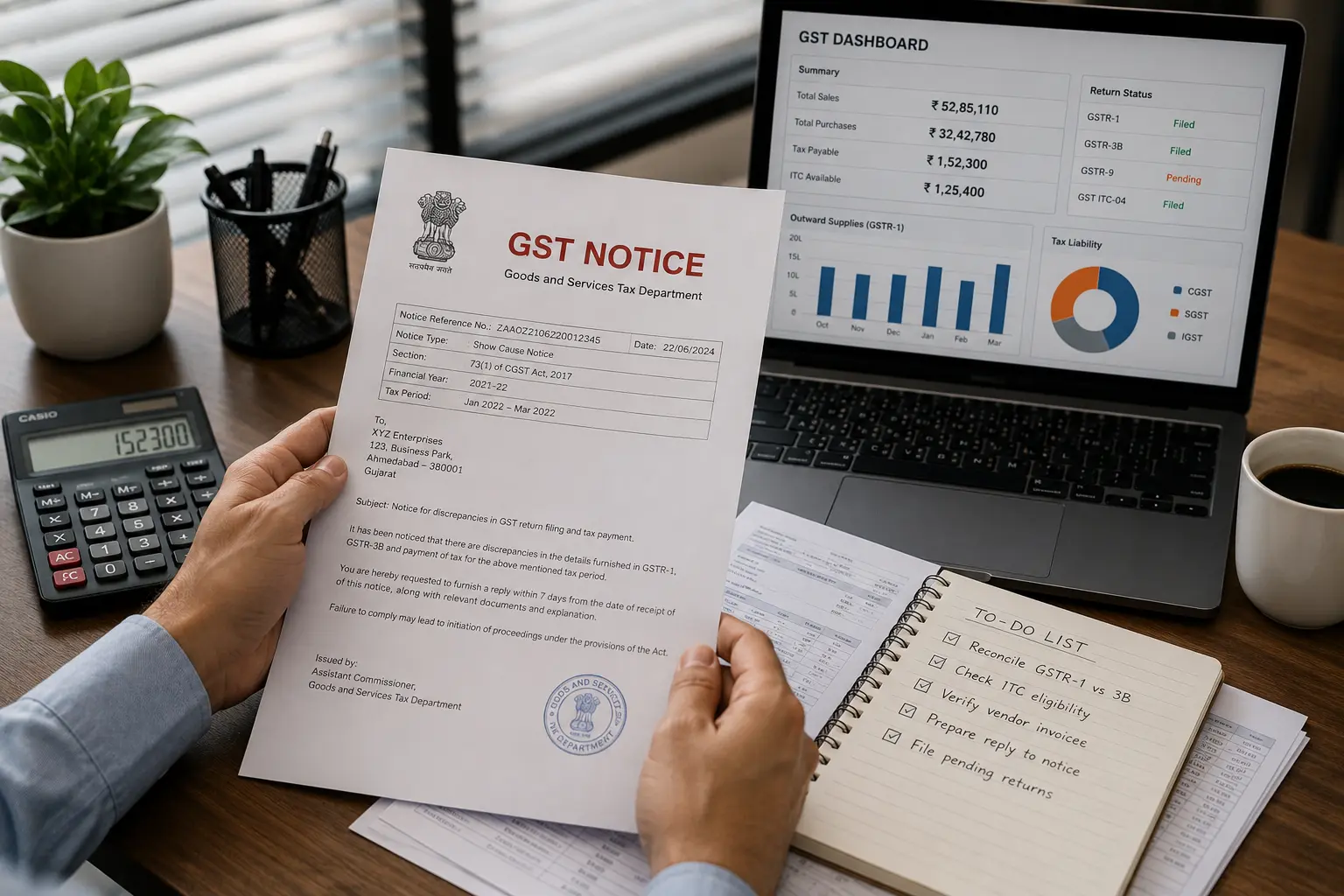
Few things create more anxiety for business owners than receiving a GST notice.
The moment the email arrives, most people assume they have done something wrong.
In reality, many GST notices are generated because of mismatches, filing errors, missing information, or simple compliance gaps, not necessarily fraud or tax evasion.
The problem is not receiving a notice.
The problem is ignoring it.
A delayed or incorrect response can lead to penalties, blocked input tax credits, additional scrutiny, and unnecessary stress.
Understanding what a GST notice means is the first step toward handling it confidently.
Why Businesses Receive GST Notices
GST notices are usually triggered when the government system identifies inconsistencies.
Common reasons include:
- Mismatch between GSTR-1 and GSTR-3B
- Incorrect Input Tax Credit (ITC) claims
- Delayed GST return filing
- Differences between GST and Income Tax records
- Non-payment or short payment of GST
- Vendor mismatch issues
- Failure to respond to previous notices
Many business owners discover these issues only after receiving a notice.
Most Common Types of GST Notices
1. Notice for Return Filing Defaults
This occurs when returns are not filed within the prescribed timeline.
Consequences may include:
- Late fees
- Interest charges
- Suspension of GST registration
2. Notice for Mismatch in Returns
Authorities may identify differences between:
- GSTR-1
- GSTR-3B
- Purchase records
- Vendor filings
These mismatches often trigger verification requests.
3. Input Tax Credit Verification Notice
This notice requests clarification regarding ITC claims.
Authorities may ask for:
- Tax invoices
- Vendor details
- Payment records
- Reconciliation reports
4. Demand Notice
A demand notice generally states that tax, interest, or penalties are payable.
Ignoring these notices can escalate the matter significantly.
What To Do Immediately After Receiving a GST Notice
Step 1: Don’t Panic
Many notices are procedural.
Read the notice carefully before assuming the worst.
Step 2: Check the Notice Reference
Verify:
- Notice number
- Tax period
- Relevant GST section
- Response deadline
Missing a deadline can create unnecessary complications.
Step 3: Gather Supporting Documents
Collect:
- GST returns
- Sales invoices
- Purchase invoices
- Bank statements
- Reconciliation reports
The stronger your documentation, the easier your response becomes.
Step 4: Identify the Root Cause
Ask:
- Was there a filing mistake?
- Is there a reconciliation issue?
- Did a vendor fail to upload invoices?
- Was ITC claimed incorrectly?
Solving the actual issue matters more than simply replying.
Step 5: Draft a Proper Response
A response should be:
- Accurate
- Professional
- Supported by evidence
- Submitted before the deadline
Poorly prepared responses often create additional notices later.
Mistakes Businesses Make When Handling GST Notices
Ignoring the Notice
This is the most expensive mistake.
Authorities assume non-cooperation when businesses fail to respond.
Submitting Incomplete Information
Providing partial documentation often triggers additional scrutiny.
Missing Deadlines
Late responses reduce flexibility and increase compliance risks.
Guessing Instead of Verifying
Many business owners respond emotionally rather than factually.
Always verify records before submitting any explanation.
How Professional GST Management Prevents Notices
A strong GST process significantly reduces notice-related risks.
Key practices include:
- Monthly reconciliation
- Vendor compliance monitoring
- Accurate return filing
- ITC verification
- Timely correction of errors
- Documentation management
Most GST problems begin months before the notice arrives.
The notice simply reveals them.
The Real Cost of Ignoring GST Compliance
Many business owners focus only on tax payments.
But the larger costs often include:
- Management distraction
- Loss of productivity
- Delayed business decisions
- Professional representation costs
- Cash flow disruption
The time spent resolving preventable compliance issues is often more expensive than the tax itself.
Conclusion
Receiving a GST notice does not automatically mean your business is in trouble.
It means something requires attention.
Businesses that maintain accurate records, perform regular reconciliations, and respond promptly can usually resolve GST notices efficiently.
The goal is not simply avoiding notices.
The goal is building a finance system strong enough that notices become rare exceptions rather than recurring problems.
Need help reviewing your GST compliance process?
A professional GST audit can identify hidden risks before they become notices, penalties, or cash-flow problems.